
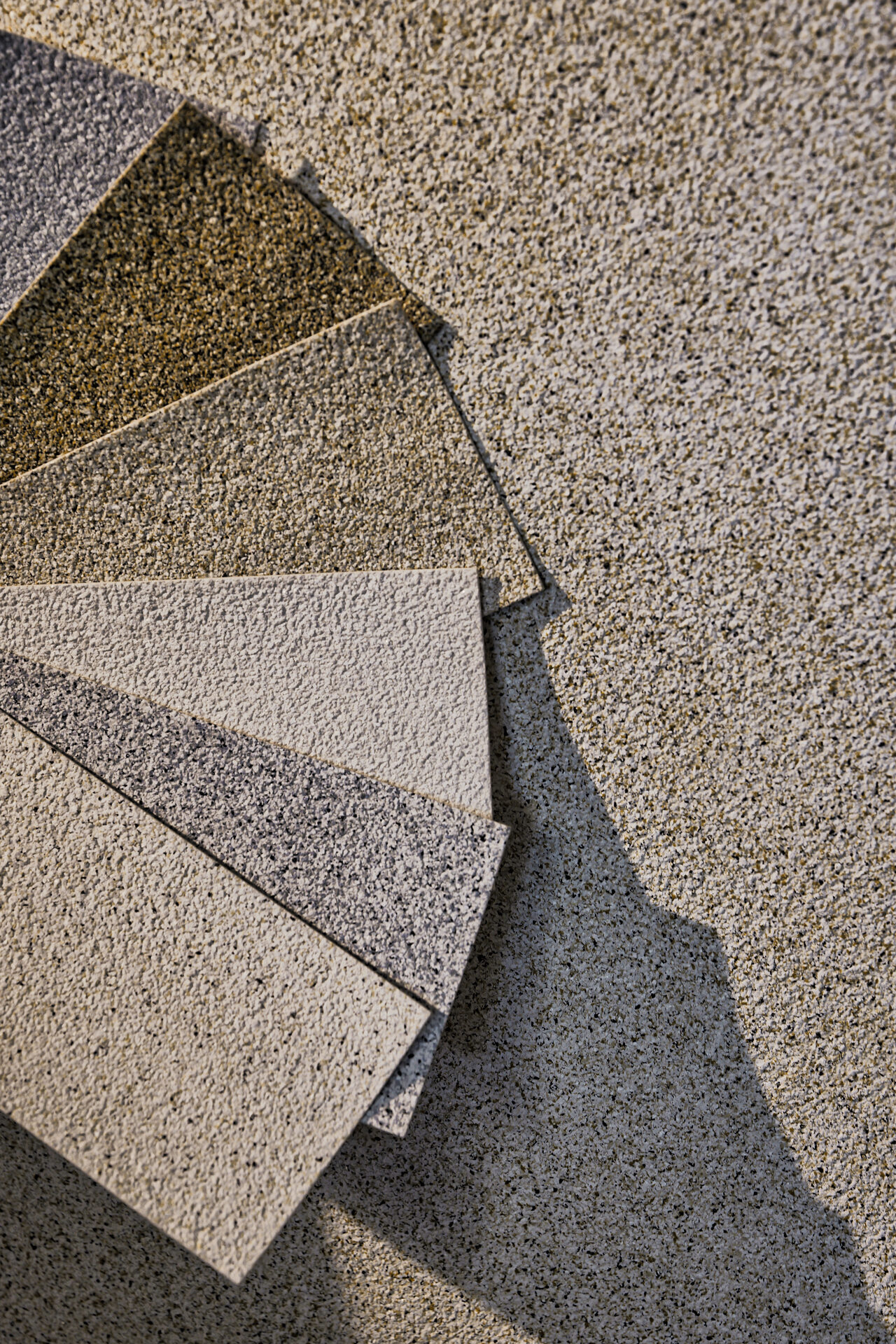
Venetian plaster, microcement and limewash all get described as 'decorative wall finishes', which is half-true and unhelpful. They're three different materials, three different applications, three different prices, and they suit three different design intents.
Here's the comparison we wish more design briefs started with.
At a glance
Venetian plaster (Marmorino, Travertino, Stoneveil)
Venetian plaster is slaked lime mixed with marble dust, applied in many thin layers and polished. The result reads like the inside of a piece of stone — depth, sheen, movement. It's the most expensive of the three and the most labour-intensive.
- Use for: feature walls, fireplaces, hospitality interiors, hotel lobbies, where you want a 'wow' surface.
- Don't use for: bathrooms (unless specifically rated), high-traffic areas with knocks, exteriors.
- Typical price: £200–£320/m² for a Marmorino Carrara finish.
Microcement
Microcement is the workhorse. It's the only one of the three that solves floors, walls and wet-zones in the same material. It reads as a single continuous surface — more architectural than decorative.
- Use for: bathrooms, kitchens, open-plan reception areas, stair runs, modern apartments.
- Don't use for: schemes that want strong tonal variation across a single wall (it's too uniform).
- Typical price: £140–£260/m² depending on application.
Limewash
Limewash is the most natural and the most affordable. It has the most movement and the most character of the three, but it has the strongest list of limitations.
- Use for: traditional plaster walls, period properties, country-house interiors, soft-tonal feature walls.
- Don't use for: wet-rooms, modern emulsion-painted walls, schemes that need a flat single tone.
- Typical price: £55–£85/m².
How to choose
- Is it a wet area? → microcement, full stop.
- Is it a single feature wall and you want maximum depth? → Venetian plaster.
- Is it a traditional property with soft tonal walls in your moodboard? → limewash.
- Is it an open-plan modern interior where bathroom, kitchen and living all need to flow? → microcement throughout.
- Is your budget the deciding factor? → limewash for walls, microcement for floors.