
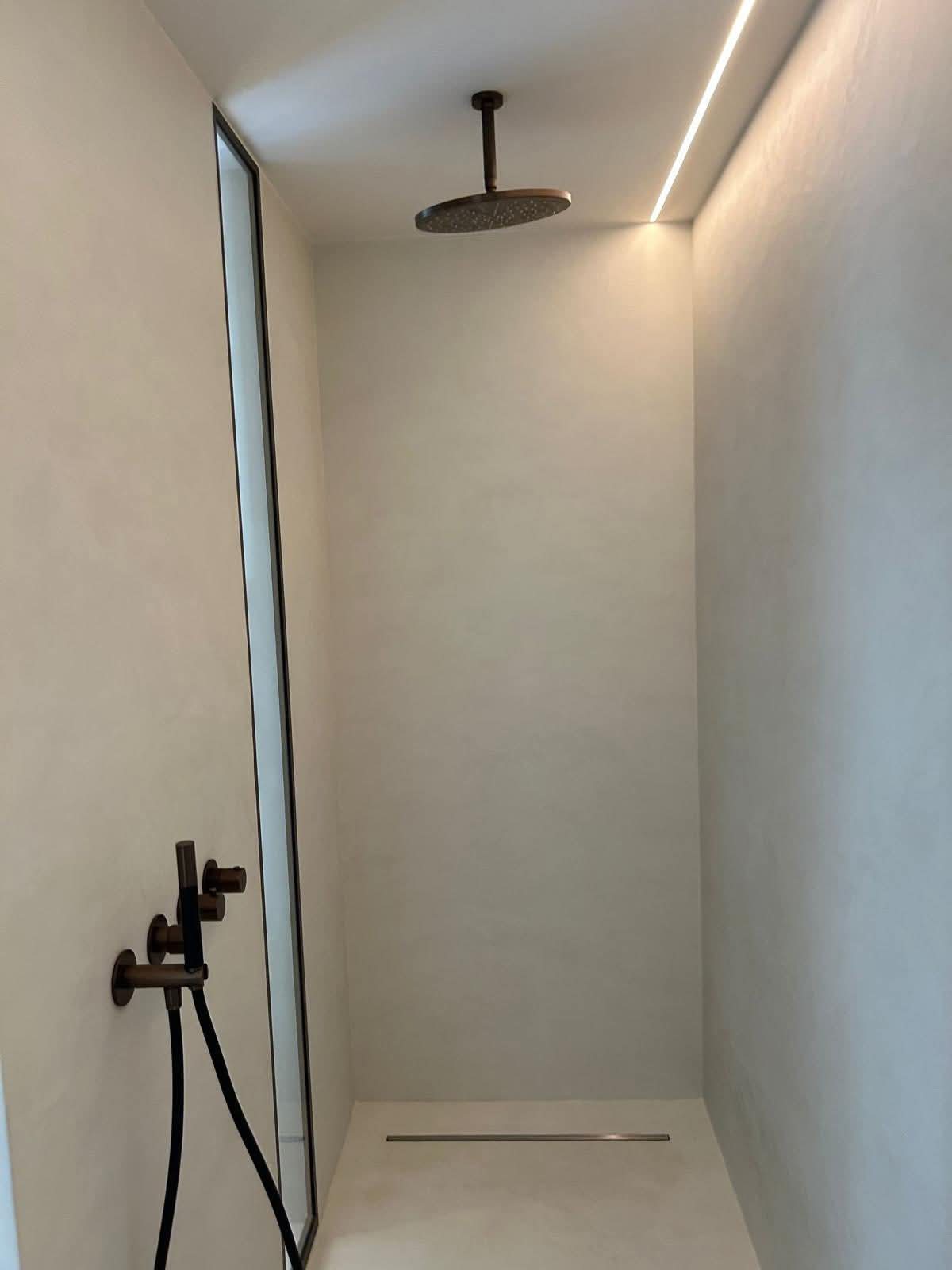
Microcement is sold as a waterproof finish, and it is — but only when installed as a system. The basecoat on its own is not waterproof, which is where most failures come from.
This guide walks through the build a credible installer should be quoting for a wet-room, and the warning signs in a quote that's missing one of the layers.
What 'waterproof microcement' actually means
A waterproof microcement system is a stack: primer, two reinforced base coats with mesh, two finishing coats, a tanking membrane, and two coats of high-performance polyurethane sealer. Remove any layer and the system stops being waterproof.
The full wet-zone build
- Substrate prep and primer — tile primer for over-tile installs, masonry primer for screed.
- Reinforcing mesh at all corners, junctions and around the drain.
- Two structural base coats — these give the system its strength and crack-resistance.
- Two pigmented finishing coats — this is where the colour and texture live.
- Liquid tanking membrane — applied over the finished surface, invisible once dry.
- Two coats of polyurethane sealer — this is the layer that actually stops water passing through.
Common failure modes
- Sealer skipped or single-coated — water permeates the finishing coat over 6–12 months.
- No mesh at substrate junctions — micro-cracks open up at the wall/floor corner.
- Wrong sealer chemistry (acrylic instead of polyurethane) — bath-temperature water wears it through.
- Sealer applied before the finishing coats have fully cured — adhesion fails and you get patches.
How long does the waterproofing last?
On walls, indefinitely — they don't take any abrasion. On floors, expect to re-seal every 5–7 years. The base layers don't go anywhere; you're just refreshing the topmost protective layer.
What to ask your installer
- Which tanking membrane do you use, and at what coverage rate?
- Which polyurethane sealer, and how many coats?
- Where exactly does the reinforcing mesh go?
- What's your re-seal interval, and is that included in the quote?