
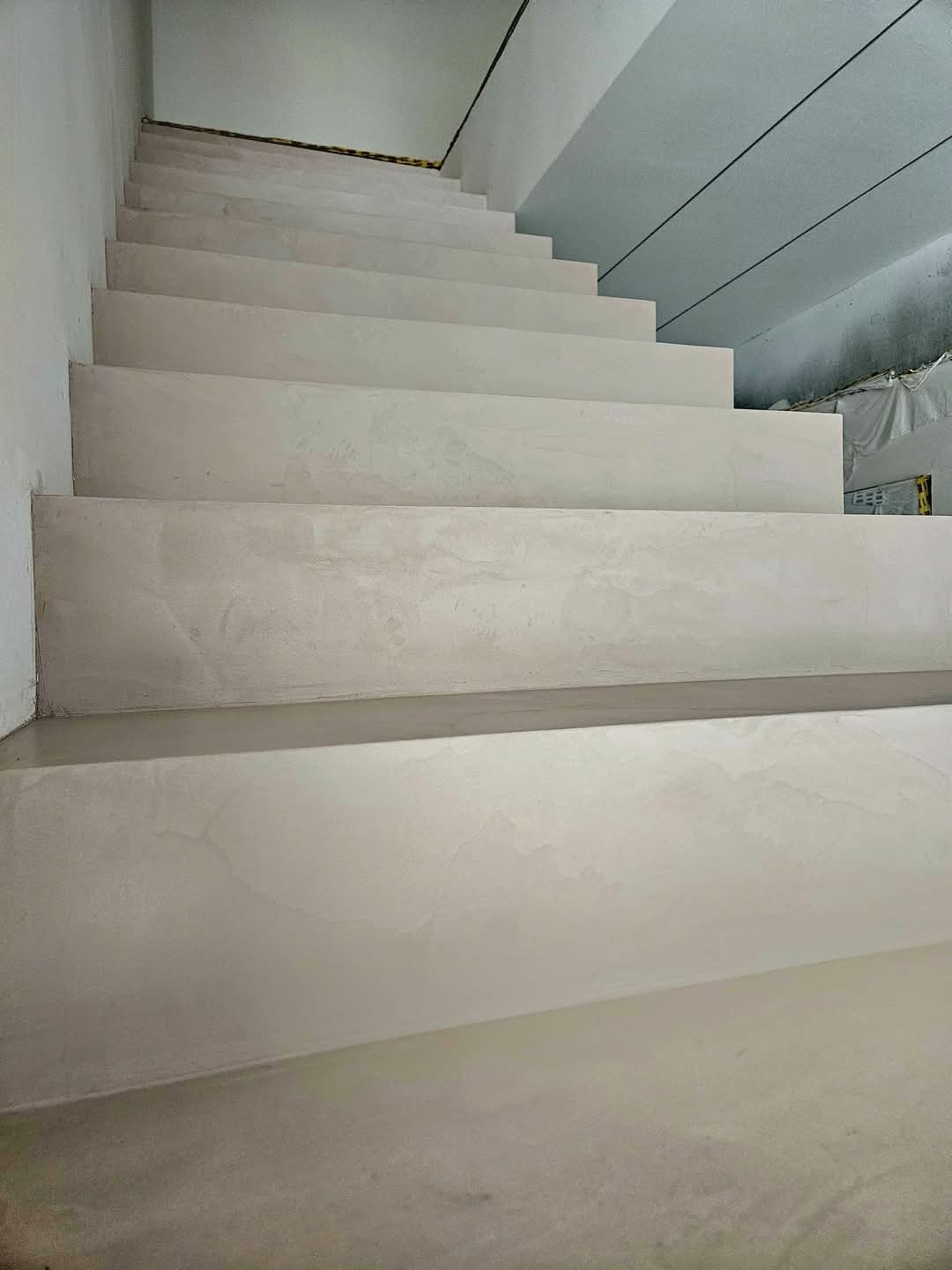
Stairs are the hardest application in microcement. They take more abuse than a floor, the geometry is unforgiving, and the joints between tread, riser and stringer are where almost every long-term failure starts.
This is a working guide to specifying a microcement staircase that will still look right in ten years.
Substrate first
A microcement stair is only as stable as what sits underneath it. Timber stairs flex; concrete stairs creep; tiled stairs were never designed to be over-coated. Each one needs a different prep — there is no universal answer.
- Timber: rigid backer board (6 mm cement board) screwed and glued across every tread and riser, with mesh-taped joints.
- Concrete: spot-fill, prime and level — but only after a moisture test confirms residual moisture is below 4%.
- Tiled: prime with a tile primer rated for foot-traffic substrates, then mesh the grout lines before basecoats.
Anti-slip is non-negotiable
A polished microcement tread is a slip-risk under socks. Every stair we install gets either an anti-slip additive in the final sealer coat, or a discrete grit-line set into the nose of each tread. Building regs Part K applies.
Joints, nosings and stringers
The micro-crack that runs along a stair nosing is the giveaway of a stair installed without a true joint detail. We chase a 2 mm relief at every tread-to-riser junction, fill it with a flexible sealant compatible with the microcement system, then over-coat. The result is a continuous look with a hidden movement joint.
Wrap, or stop?
Two stylistic choices set the tone of the whole staircase: do you wrap the stringer in the same microcement, and do you carry the colour onto the landing floor? Wrapping the stringer reads as a sculpted concrete cast; stopping at the stringer reads as a coated tread on a separate timber frame. Both are valid; neither is cheaper.