
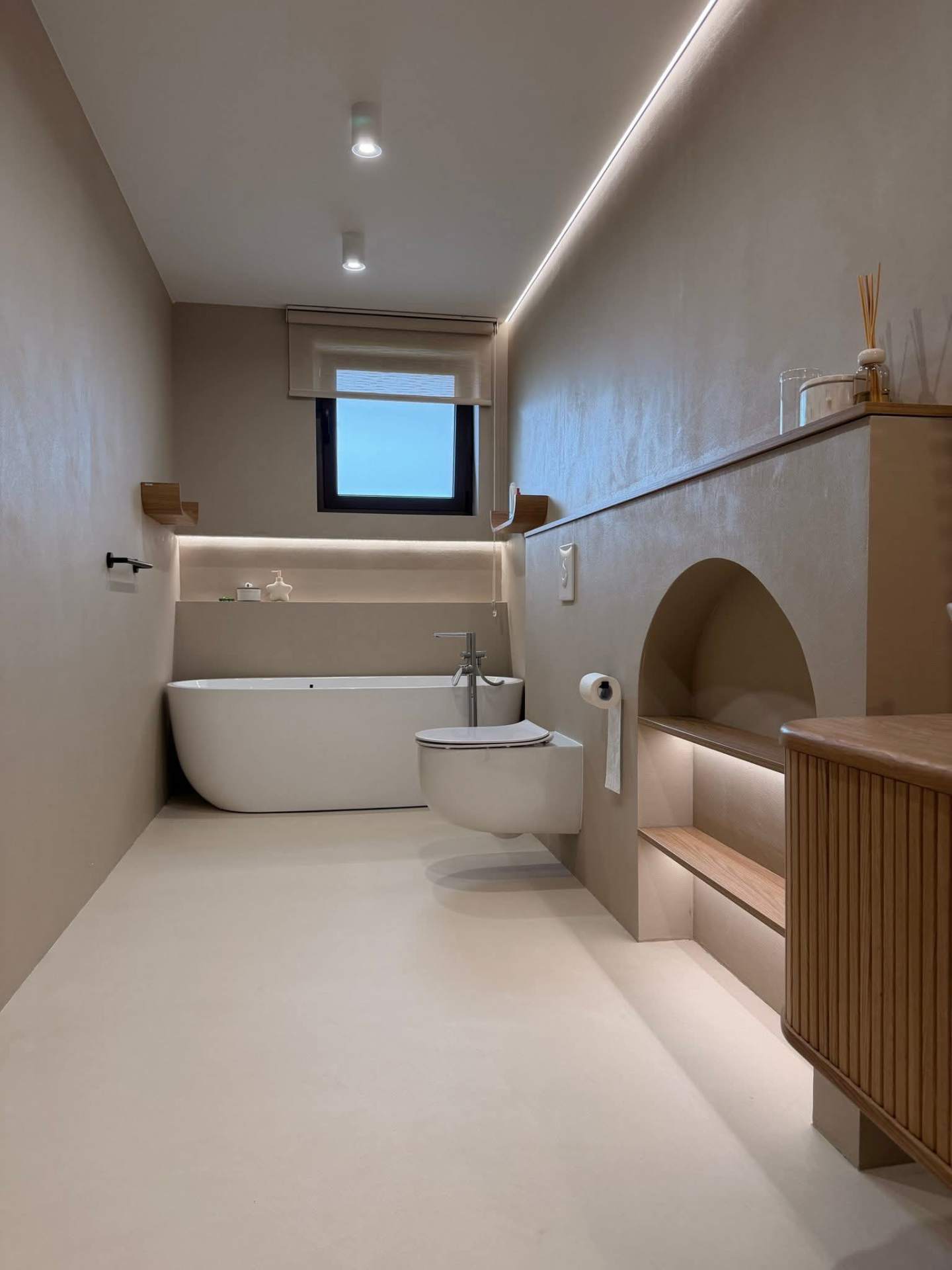
Is microcement more expensive than tiles? It depends on the specification. Microcement is labour-intensive, while tile costs vary widely with the chosen tile, layout and cutting. A fair comparison must include preparation, waterproofing, trims, grout and installation rather than comparing surface materials alone.
Microcement and tiles solve the same problem — a waterproof, hard-wearing bathroom surface — but they get there in very different ways. This guide compares them head-to-head for UK projects, from a renovation in a Victorian terrace to a new-build wet-room.
Where you'll see the biggest difference: not in cost, but in the look, the level of grout, and how the room reads as a single space.
The short answer
If you want a seamless, contemporary, grout-free bathroom and you're working with a competent installer, microcement is the stronger choice. If your scheme is traditional, you need a complex layout of niches and decorative inserts, or your budget is very tight, high-quality tiles still win.
Cost: like for like
Microcement is more labour-intensive but uses less material; tiles are the opposite. Once you account for grout, edge trims, tanking and decorative inserts, a high-end tiled bathroom usually lands above a comparable microcement one.
Installation time
- Microcement bathroom (6 m²): 5–7 working days, including drying and sealer build.
- Tiled bathroom (6 m²): 4–8 working days depending on cuts and layout complexity.
- Microcement has fewer scheduling stop-starts (no separate tanking trade), which usually shortens the overall programme.
Maintenance over 10 years
Tiles need grout re-sealing every 1–2 years and grout replacement every 7–10. Microcement needs a top-up sealer coat every 5–7 years on floors, and almost nothing on walls. Neither is maintenance-free; both are practical.
The look
Microcement reads as one continuous surface — floor, walls, shower bench, vanity skirt all in the same tone. There's no grid, no visual interruption. Tiles do something different: pattern, layout, decorative inserts and grout colour are part of the design language.
Where tiles still win
- Complex niche-heavy layouts where every reveal would otherwise need a separate microcement detail.
- Period properties where the joinery and floor pattern are part of the heritage.
- Self-build or DIY projects — microcement is unforgiving without training.
- Bathrooms with very high-traffic shared use (gym, hotel back-of-house) where chipped grout can be swapped tile-by-tile.
Where microcement wins
- Walk-in wet-rooms with no shower tray.
- Small bathrooms where grout lines visually shrink the room.
- Apartments where minimising floor build-up height matters.
- Schemes where you want bathroom, bedroom and hallway to flow as one surface.
Verdict
For a contemporary bathroom where a continuous, grout-free finish is the priority, microcement can be the stronger choice. For traditional or pattern-led schemes, stay with tiles.